
Virginia window tint laws allow aftermarket film, but the legal percentage changes by window and vehicle class. Front side windows must retain at least 50% total light transmission. Most passenger-car rear windows must retain at least 35%. Qualifying SUVs, multipurpose vehicles, and pickups can use darker rear film.
Speed & Tech Motoring serves drivers in Sterling and across Northern Virginia. This guide explains the 2026 rules in plain language. It covers VLT, windshields, medical authorization, reflectivity, measurement, violations, and vehicle classifications.
Virginia Window Tint Laws at a Glance
Virginia permits window film when the finished glass meets the state’s current tint requirements. The law measures the complete window, not the film label alone. Existing factory glass and added film work together to create the final reading.
| Window | Passenger car | SUV, pickup, or qualifying MPV |
| Windshield | Manufacturer’s upper sunshield area; compliant clear film may be allowed | Same standard |
| Front side windows | At least 50% total VLT | At least 50% total VLT |
| Rear side windows | At least 35% total VLT | May be below 35% |
| Rear window | At least 35% total VLT | May be below 35% |
| Maximum reflectance | 20% | 20% |
The rear-window exception does not automatically exempt every SUV. Virginia defines a multipurpose passenger vehicle by its design, capacity, chassis, and off-road features.Virginia also allows pickup trucks to use rear-window film below the standard 35% limit.
What Does VLT Mean for Window Tint?
Visible Light Transmission, or VLT, measures how much visible light passes through the glass and film. A 70% reading looks light because it transmits most visible light. A 5% reading looks very dark because it transmits little light.
| VLT | General appearance | Common legal relevance in Virginia |
| 70% | Nearly clear | Common for clear or very light film discussions |
| 50% | Light tint | Minimum total VLT for front side windows |
| 35% | Moderately dark | Minimum total VLT for passenger-car rear glass |
| 20% | Dark | Not legal on front sides; may fit qualifying MPV or pickup rear glass |
| 5% | Very dark | Not legal on front sides or ordinary passenger-car rear glass |
Film shade and final VLT are not the same measurement. For example, film rated at 70% applied over glass that transmits 80% of light produces about 56% theoretical VLT. Actual readings can vary, so an installer should measure the glass instead of relying only on multiplication.
Legal Tint Percentages for Passenger Cars in Virginia
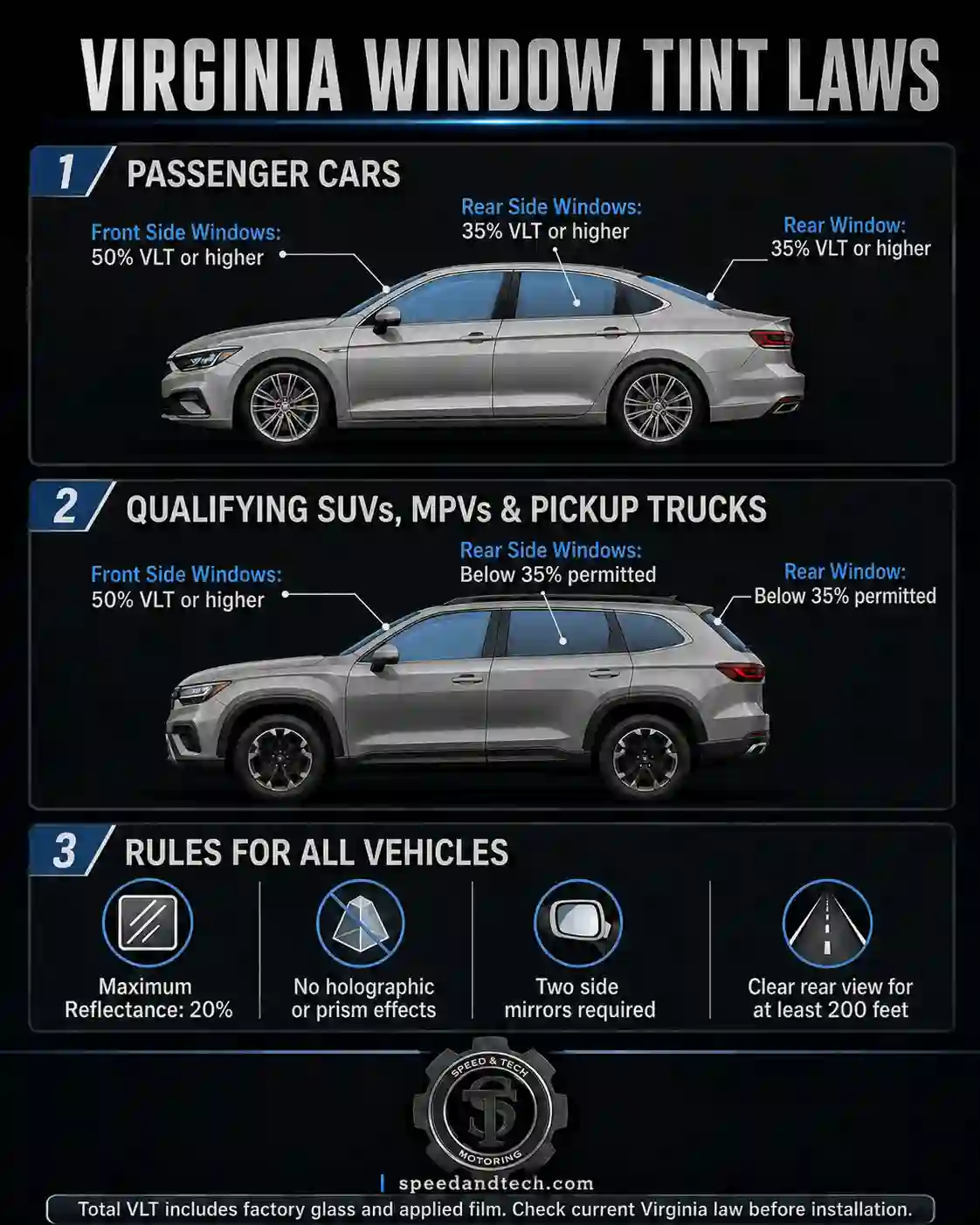
Passenger cars include common sedans, coupes, hatchbacks, and station wagons. Their front side windows must maintain at least 50% total light transmission. Rear side windows and the rear window must maintain at least 35%.
| Passenger-car glass | Legal requirement |
| Driver and front-passenger side windows | 50% VLT or higher |
| Side windows behind the driver | 35% VLT or higher |
| Rear window behind the passenger compartment | 35% VLT or higher |
Speed & Tech Motoring measures existing glass before recommending window tinting in Sterling, VA. This matters near the legal threshold. A 50% film can result in a finished reading below 50% when the original glass already reduces some light.
Legal Tint Percentages for SUVs, Trucks, and Multipurpose Vehicles
SUVs, crossovers, vans, and pickups don’t follow one universal rule for every pane. The front side windows still need at least 50% total VLT. The difference applies to rear side windows and the rear window.
Virginia defines a multipurpose passenger vehicle as one designed for no more than ten people and built on a truck chassis or with special features for occasional off-road operation. Subsection H permits rear side and rear glass below 35% on qualifying MPVs and pickup trucks. This makes 20% or 5% rear film possible under the darkness rule, but other requirements still apply.
A vehicle’s registration label, body style, factory classification, and construction can help establish its class. Drivers should not assume that marketing language alone settles the issue. Measure the front glass and confirm the vehicle class before choosing different front and rear shades.
Virginia Windshield Tint Rules
Standard windshield rules differ from side-window percentage limits. Virginia generally prohibits film or darkening material on the windshield except in the uppermost area that replaces the manufacturer’s sunshield. The statute does not give every vehicle a general right to a dark five-inch strip.
Virginia permits clear windshield film when the finished glass still meets federal automotive-glass safety requirements. A product advertised as clear or light does not automatically qualify. Film selection, finished light transmission, condition, and placement all matter.
At the Sterling Park auto protection shop, Speed & Tech Motoring can review the windshield markings and proposed film before installation. Medical authorization follows separate limits discussed below.
Reflectivity, Mirrors, and Other Virginia Tint Rules
Legal darkness is only one part of compliance. Applied film cannot reflect more than 20% of light. It also cannot create a holographic or prism effect. A film can meet the VLT limit and still violate one of these restrictions.
Virginia also requires a mirror on each side of a vehicle with applied tinting film. The mirrors must give the driver a view of the highway for at least 200 feet behind the vehicle. This requirement matters most when dark rear film reduces the view through the back glass.
Virginia law directly limits reflectivity and prohibits films that create holographic or prism effects. Shops and third-party websites sometimes publish broader lists of prohibited colors. Use the current Virginia Code before treating a color name as a statewide statutory ban.
How Virginia Measures Window Tint and Applies the 7-Point Tolerance
Virginia law regulates total light transmission through the finished window. Law-enforcement officers must use devices that meet state standards. Virginia law gives measurements taken by law-enforcement officers a tolerance of minus seven percentage points.
That tolerance is an enforcement rule, not permission to design a front window for a 43% reading. The legal minimum remains 50%. Film, glass, meter variation, aging, and installation conditions can change the final result. A compliant installation should meet the legal minimum while leaving a practical measurement buffer.
The most reliable process starts with a meter reading on the untreated glass. The installer then selects film based on the desired finished result. A post-installation reading confirms the actual VLT instead of assuming the number printed on the film sample equals the finished glass.
Medical Window Tint Exemptions in Virginia
Virginia offers a medical sun-shading authorization for a person susceptible to harm from sunlight or bright artificial light. A licensed physician or optometrist must support the need. The applicant should obtain written DMV authorization before adding film outside the standard limits.
With authorization, windows may transmit at least 35% of light. A full windshield must retain at least 70% total light transmission. The upper five inches or AS-1 area, whichever sits closer to the windshield top, may retain at least 35%.
The authorization applies to a vehicle operated by or regularly used to transport the qualifying person. It remains valid while the medical condition persists or until the vehicle is sold, whichever comes first. The driver or an occupant must possess the written authorization while the vehicle operates on a Virginia highway.
Virginia Tint Violations, Police Stops, and Corrections
Operating a vehicle with film below the required VLT, above 20% reflectance, or with a prohibited holographic or prism effect is a traffic infraction. The Commissioner does not assign demerit points for this tint violation. The installer faces a separate rule: applying noncompliant film can bring a Class 3 misdemeanor for a first offense and a Class 2 misdemeanor for a later offense.
An officer cannot stop a motor vehicle solely for violating § 46.2-1052. A tint issue may still arise during another lawful interaction. A court may dismiss a summons at its discretion when the driver provides proof of compliance on or before the court date. Removal or replacement records can support that proof.
Virginia’s safety inspection rules examine glass, vision obstructions, windshield sunshading, film condition, mirror setup, and other glazing issues. The inspection regulation does not make every dark side-window reading an automatic rejection item. Legal operation under the tint statute and the inspection checklist remain related but distinct compliance questions.
Choosing Legal Window Film for Heat Rejection
Darker film is not the only way to reduce cabin heat. Modern ceramic films can reject infrared energy while maintaining a lighter appearance. That distinction helps Virginia drivers meet front-window limits without sacrificing heat and UV performance.
Dyed film mainly changes appearance and offers limited heat control. Carbon film adds color stability and moderate heat rejection. Nano-ceramic film offers stronger heat rejection without metallic signal interference. Product specifications vary, so compare the exact film series rather than relying only on the word ceramic.
Drivers can review choosing the best legal window tint before selecting a shade. The final choice should account for untreated glass VLT, vehicle class, window position, night visibility, heat-control goals, and the finished meter reading.
Check the Official Virginia Tint Statute
Virginia can amend motor-vehicle laws. The current Code of Virginia § 46.2-1052 controls the standard definitions, percentages, reflectance limit, measurement tolerance, penalties, vehicle exceptions, and stop restriction discussed in this guide.
Drivers seeking a medical exception should review the Virginia DMV medical authorization process and Form MED-20 before installation. A shop recommendation cannot replace written DMV authorization or legal advice about an individual case.
Summary
Virginia’s 2026 window tint rules require at least 50% total VLT on front-side windows. Passenger-car rear glass must retain at least 35%. Qualifying MPVs and pickups may use darker rear film. Windshield placement, 20% reflectance, mirror requirements, and medical rules also affect compliance.
Speed & Tech Motoring can measure existing glass and explain legal film options for Sterling drivers. Those comparing packages can also review window tint costs in Sterling before choosing coverage and film performance.
Frequently Asked Questions
What is the darkest legal window tint for a sedan in Virginia?
Virginia sedans need at least 50% total VLT on the front side windows and at least 35% on the rear side windows and rear window. The finished glass-and-film reading controls, not the film label. Measure factory glass first and leave a practical compliance buffer. This limits risk.
Can an SUV or pickup truck legally use 20% tint on its rear windows in Virginia?
Yes, a qualifying multipurpose passenger vehicle or pickup may use rear side and rear-window film below 35% VLT, so 20% can comply with the darkness rule. Front side windows still need at least 50% total VLT, and reflectance cannot exceed 20% on any treated window. Check mirrors too.
Can police pull me over only because my window tint looks too dark in Virginia?
No. Code of Virginia § 46.2-1052(P) says an officer shall not stop a vehicle solely for a violation of that tint section. A tint issue can still arise during another lawful interaction. Noncompliant operation remains a traffic infraction, but it carries no DMV demerit points. Keep records.
Does factory privacy glass count when Virginia window tint is measured?
Yes. Virginia regulates total light transmission through the completed window, so factory glass and added film work together. A 50% film does not guarantee a 50% finished reading. A shop should meter untreated glass, calculate a suitable film, and confirm VLT after installation. Keep the reading.
What window tint can Virginia medical authorization permit on the windshield?
Virginia medical authorization can permit at least 70% total VLT across the full windshield. The upper five inches or AS-1 area, whichever is closer to the top, may be at least 35%. Obtain DMV approval before installation and keep the written authorization in the vehicle. Keep it available.
Does Virginia’s seven-point measurement tolerance make 43% front tint legal?
No. The statutory minimum for front side windows remains 50% total VLT. The minus-seven-point provision applies to measurements made by law-enforcement officers; it is not a target for installation. Use measured factory glass and a practical buffer to reduce compliance risk. Do not target 43%.