
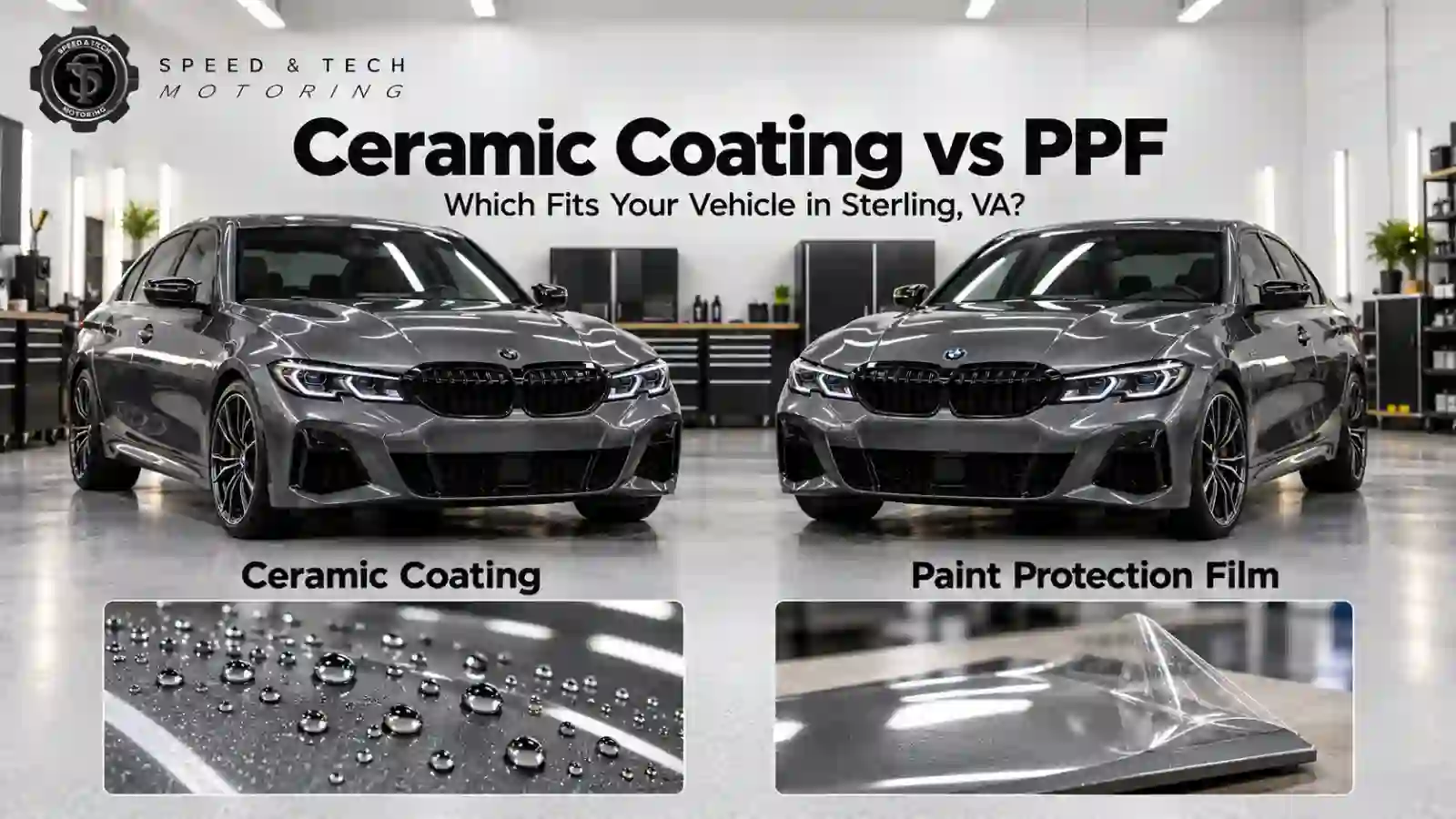
Ceramic coating vs PPF is a choice between two different kinds of paint protection, not two versions of one product. Speed & Tech Motoring helps Sterling, VA drivers match each option to risks like Route 28 gravel and winter brine.
Ceramic coating adds gloss and makes washing easier, while paint protection film in Sterling, VA helps absorb rock chips and scuffs. The right pick depends on the vehicle, the commute, and the condition of the paint.
Which Is Better, Ceramic Coating or PPF?
Neither option wins in every situation, because each one protects against different damage. PPF is the stronger choice for rock chips, road debris, and scuffs. Ceramic coating is the stronger choice for gloss, easier washing, and resistance to environmental contamination.
A quick decision guide helps most drivers:
- Choose PPF first when rock chips and highway debris are the main worry.
- Choose ceramic coating first when gloss, easy cleaning, and contamination resistance matter most.
- Choose both when a vehicle is new, valuable, or driven daily on busy highways.
Paint condition affects both services. A smooth, well-prepared surface matters as much as the product chosen.
How Do Ceramic Coating and PPF Protect Paint Differently?
How Ceramic Coating Works
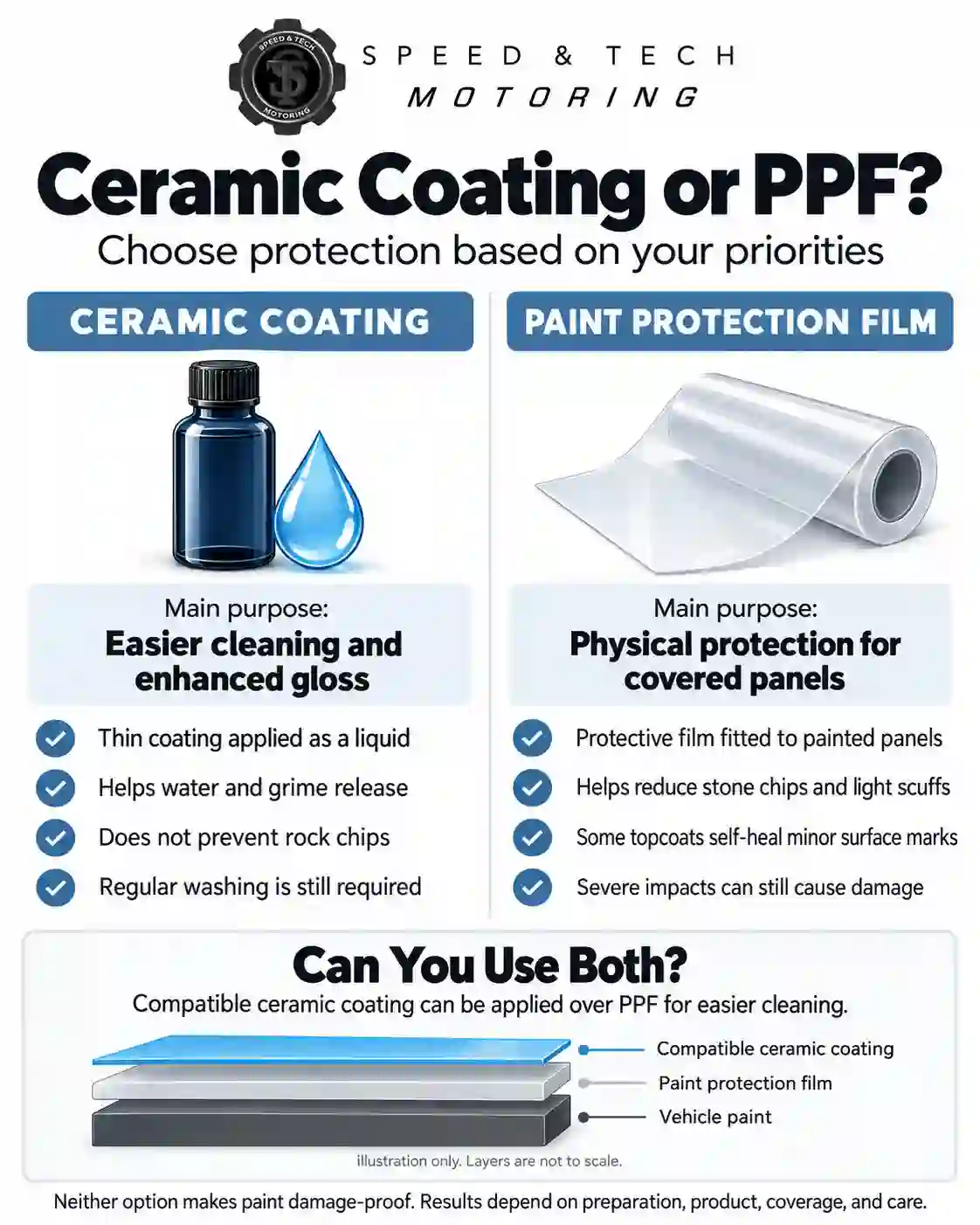
Ceramic coating is a liquid formula that cures into a thin, hard layer on the clear coat. That layer measures only a few microns, so it adds surface chemistry rather than bulk. Unlike wax, it is designed to stay on the paint through repeated washes.
Our Installers at Speed & Tech Motoring apply XPEL FUSION PLUS ceramic coating after washing, decontamination, and any needed paint correction. Product tiers differ, so layer counts and warranty terms change by package.
How Paint Protection Film Works
Paint protection film is a clear thermoplastic urethane layer installed on painted panels. The material began as protection for military helicopter rotor blades before reaching automotive use. XPEL lists its ULTIMATE PLUS film at 8 mil thick, which is far thicker than any coating layer.
That thickness lets film absorb and spread small impacts before they reach the paint. Film is cut and fitted panel by panel, so coverage becomes a choice made area by area.
What Does PPF Protect Against, and What Can It Not Stop?
Film is a sacrificial layer. It takes the hit so the paint underneath does not. Installers place it on bumpers, hoods, fenders, and mirrors because those panels collect the most debris.
PPF can help with:
- Rock chips and gravel spray on high-impact panels
- Light scuffs from loading, door edges, and daily contact
- Bird droppings and bug residue, which sit on the film instead of the paint
- Minor scratches and swirl marks on the film surface, through self-healing
PPF cannot:
- Stop every impact, since XPEL notes that severe impacts may still cause damage
- Heal deeper scratches that cut through the film
- Correct paint defects that already exist before installation
- Protect panels the film does not cover
Self-healing needs warmth from sunlight, warm water, or a heat gun, and results depend on the film line.
What Does Ceramic Coating Protect Against, and What Can It Not Stop?
Sterling drivers deal with pollen, tree sap, bird droppings, and winter road film. Speed & Tech Motoring recommends ceramic coating mainly for contamination resistance. The coating helps contaminants release from paint, but it does not make paint immune to them.
Ceramic coating can help with:
- Bird droppings, tree sap, and bug residue, which release more easily from a coated surface
- Road salt and winter film, which wash off with less effort when removed promptly
- Chemical etching from environmental fallout, as part of a regular wash routine
Ceramic coating cannot:
- Stop rock chips, dents, or deep scratches
- Remove the need for regular washing
- Prevent water-spot etching when mineral deposits sit for long periods
- Match the impact absorption of film
A “9H” label refers to a pencil hardness test on a coating sample. It does not predict how paint handles gravel, brushes, or keys. Manufacturer UV claims also vary, so a coating supplements clear coat rather than replacing it.
How Do PPF and Ceramic Coating Compare on Gloss, Water Beading, and Cleaning?
Gloss and Appearance
Ceramic coating adds depth and reflectivity, and the result depends on the paint beneath it. Clear film keeps the factory look, while matte film changes the finish on purpose.
Water Beading and Easier Cleaning
Hydrophobic behavior is the core strength of ceramic coating. Water beads and sheets away, and road film releases more easily during a wash. Some films offer a hydrophobic top layer, but results vary by product.
Which Is Better for Rock Chips, Scratches, and Swirl Marks?
Rock Chips and Road Debris
PPF is the better answer. Ceramic coating is too thin to absorb gravel impacts, and coating makers say it is not built to stop chips.
Impact energy rises with speed, so gravel thrown at highway speed does far more damage than parking-lot grit.
Light Scratches and Swirl Marks
Swirl marks are fine scratches, usually caused by washing and drying. Film’s self-healing top coat handles minor marks on its own surface, not the paint beneath. Ceramic coating cannot self-heal, though a slick surface can make safe washing easier.
Swirls already in the paint call for paint correction instead.
How Do Sterling, VA Roads and Weather Change the Choice?
Winter Road Treatment
Virginia crews pretreat and salt roads before winter storms. The resulting brine and grit collect on lower doors, rocker panels, and rear bumpers.
Ceramic coating makes that film easier to wash off, while film shields leading edges from grit thrown by traffic.
Spring Pollen, Summer Sun, and Highway Commutes
Pollen and tree sap settle on horizontal panels each spring, and summer heat can bake contamination onto warm paint. Washing soon after heavy pollen keeps either product performing as intended.
Daily trips on Route 28, the Dulles Toll Road, and I-66 mean heavy truck traffic. Front-end panels on those corridors collect gravel exposure fastest.
Ceramic Coating vs PPF Comparison Table
This table summarizes how the two services compare across the factors drivers ask about most.
| Factor | PPF | Ceramic Coating |
| Physical impact protection | Helps absorb rock chips, gravel, and light scuffs | Minimal, and not designed to stop chips |
| Light scratches and swirls | Self-healing top coat can recover minor marks on the film | No self-healing, and not scratch-proof |
| Chemical and contaminant resistance | Barrier keeps contaminants off paint, with stain resistance varying by film | Contamination releases more easily, but prompt removal still matters |
| Gloss and appearance | Clear film keeps the factory look, and matte film changes the finish | Adds gloss and depth to healthy paint |
| Hydrophobic behavior | Varies by film, and a ceramic top layer can add it | Core strength, with water beading and sheeting |
| Cleaning and maintenance | Hand wash with soft tools, and follow warranty inspection terms | Gentle shampoo, periodic decontamination, and warranty terms |
| Coverage | Panel by panel, from partial front to full body | Whole exterior, plus glass, wheels, and trim |
| Removal | Professional removal with heat | Wears over time, and removal needs machine polishing |
| Best use cases | Highway commuters, new and luxury vehicles, leased vehicles | Gloss-focused owners, easier washing, garage-kept cars |
| Main cost drivers | Coverage area, film line, and panel complexity | Coating tier, layers, paint correction, and vehicle size |
What Is the Difference Between Full-Front, Partial-Front, and Full-Body PPF?
Coverage level is the biggest decision in any PPF quote. Each tier adds panels and cost.
- Partial front: front bumper, part of the hood, and mirrors
- Full front: adds the full hood, fenders, and headlights
- Track pack: extends film to rocker panels and rear high-wear areas
- Full body: every exterior painted panel
Partial front suits drivers focused on highway chips on a budget. Full front is a common starting point because it covers the panels that take the most hits. Full body fits owners who plan to keep a vehicle long term.
Ceramic coating can cover any painted panels that film does not.
Why Does Paint Preparation Matter Before PPF or Ceramic Coating?
Both services lock in the paint condition beneath them. Film placed over swirl marks leaves those marks visible through the clear layer. A coating sealed over haze keeps hazy paint looking hazy.
Paint correction uses machine polishing to level defects within the clear coat. It cannot repair rock chips with missing paint or scratches that reach the color coat or primer. Installers measure paint depth first to decide how much polishing the clear coat can safely support.
New vehicles often need only light correction before protection. Used vehicles with years of wear typically need a two-step correction, which adds time and cost to the final quote.
Which Option Fits a Daily Driver, New Car, Luxury Car, or High-Mileage Vehicle?
Daily Drivers
Daily wear is steady rather than dramatic, so protection should match the routine. Film on the front end handles the main impact risk. Coating on remaining panels adds easier washing when budget allows.
New Vehicles
Fresh paint needs little correction, so both products bond to a clean base. Protecting paint before the first chips and swirls appear gives the best long-term result.
Luxury and Enthusiast Vehicles
Repaint costs and finish standards run higher on luxury and performance models. That pushes many owners toward fuller film coverage, with ceramic coating layered over it. Panel curves add labor, so quotes vary by model.
High-Mileage Vehicles
Existing chips and swirls stay visible beneath either product, so paint correction comes first. Film protects only intact paint, so panel condition matters more than mileage.
Does Combining PPF and Ceramic Coating Make Sense?
For many vehicles, yes, because the two services cover different gaps. Film handles impact, while ceramic coating adds gloss, hydrophobic behavior, and easier cleaning on top of it. Combined packages cost more than either service alone.
Ceramic coating can go over PPF, and XPEL’s published FAQ states that FUSION PLUS will not void its PPF warranty. Matte film typically calls for a satin-specific coating, since XPEL designs FUSION PLUS SATIN for satin paint and STEALTH film.
The order matters. Film bonds directly to clean paint, so ceramic coating belongs on top of it, not beneath it. Film applied over an existing coating can suffer adhesion problems, so installers generally avoid that sequence.
How Should Budget, Ownership Length, and Parking Habits Guide the Decision?
Budget does not have to force an either-or choice. Many owners start with film on the highest-impact panels. You can apply ceramic coating over film later.
Ownership length matters because film is removable by a professional, which suits leased vehicles and shorter ownership. Longer ownership gives more time for chips and swirls to accumulate, which strengthens the case for broader film coverage.
Parking and washing habits also count. Garage-kept weekend cars meet less debris, so coating alone may fit them. Outdoor-parked commuters face more contamination and gravel, which favors a combined approach.
How Does Maintenance Differ for PPF and Ceramic Coating?
PPF Care
XPEL recommends a two-bucket hand wash with a soft microfiber mitt and microfiber drying towels. XPEL also describes touchless washes as safe after the initial cure period. Brush-style automatic washes can scratch film and catch its edges, so many installers advise against them.
Follow the installer’s cure instructions before the first wash. Removing contaminants quickly helps keep the film looking clear.
Ceramic Coating Care
Regular washing is still required, because the coating eases cleaning without eliminating it. Gentle shampoos and soft drying tools protect the finish, while harsh or abrasive cleaners wear it down. Bonded road film may need an occasional decontamination wash to restore slickness.
Many film and coating warranties carry inspection and care requirements. Owners should read those terms before choosing a package.
How Long Do PPF and Ceramic Coating Last?
Lifespan depends on the product, installation, environment, and care, so no single number fits every vehicle. Parking, mileage, winter salt, and wash habits all change results.
XPEL states that PPF typically lasts five to 10 years, depending on film quality, installation technique, and environmental conditions. Published FUSION PLUS ceramic coating warranties range from one year for Lite to eight years for Premium.
Warranty terms describe coverage, not a countdown to failure. Coating performance usually fades gradually, so comparing quotes by year count alone can mislead.
How Do Installation Time and Repairs Compare?
Coating appointments generally run one to three days, including preparation and cure time. One-step correction adds one to two days, and two-step correction adds two to three. Film time scales with coverage, so a partial front finishes sooner than a full body job.
You can replace a damaged film panel on its own. XPEL notes that deeper scratches may need professional repair or replacement. Damaged coating usually needs local polishing and recoating of the affected panel.
How Much Do Ceramic Coating and PPF Cost in Sterling, VA?
Coverage, product tier, vehicle size, and paint condition drive both prices. These 2026 estimates for Sterling, VA are ranges, not quotes, and final pricing depends on inspection.
| Service | Typical 2026 Range | What Changes the Price |
| Ceramic coating, full exterior | $600 to $2,500 | Coating tier, layers, warranty length, correction, vehicle size |
| PPF, partial front | $600 to $1,200 | Film line and panel shapes |
| PPF, full front | $1,500 to $3,000 | Added hood, fenders, and headlights |
| PPF, track pack | $2,500 to $4,500 | Rocker panels and rear high-wear areas |
| PPF, full body | $5,000 to $8,000+ | Every painted panel, plus size and luxury premiums |
Paint correction adds labor and is quoted by paint condition. Independent national guides publish wider, higher ranges because labor rates and film brands vary by region.
A lower upfront price does not always mean a lower cost per year. Comparing warranty, preparation, and coverage gives a clearer picture than price alone. No film or coating guarantees a specific resale increase.
What Should Drivers Ask an Installer Before Booking PPF or Ceramic Coating?
Quote comparisons only work when each shop answers the same questions. These six questions make estimates easier to compare.
- Which exact film or coating product and tier will be used?
- What do the warranty terms cover, and what inspections or care steps do they require?
- How will paint depth be measured, and what correction does the quote include?
- Which panels are covered, and how are edges and complex curves handled?
- How long is the cure period, and when is the first wash allowed?
- Is the quote written, itemized, and clear about extras such as glass or wheels?
Clear answers signal a prepared installer. Vague answers often point to rushed preparation, which is a common cause of early coating and film problems.
Conclusion
Ceramic coating and PPF solve different problems, so the right choice follows the main risk. PPF suits rock chips and road debris. Ceramic coating improves gloss and makes cleaning easier, and combining them covers both at a higher cost.
Each Sterling vehicle gets a paint inspection, a route review, and a tailored quote from Speed & Tech Motoring. Drivers can read about ceramic coating cost in Sterling, VA before booking.
Frequently Asked Questions
Is PPF better than ceramic coating for a brand-new car in Sterling, VA?
PPF is better for rock chip protection, so many new-car owners film the front panels first. Ceramic coating adds gloss and makes washing easier, and pairing both is common. Fresh paint needs little correction, which keeps prep cost lower and gives both products a clean, smooth, stable base.
Can you put ceramic coating over paint protection film?
Yes. Ceramic coating can go over PPF, and XPEL states that FUSION PLUS will not void its PPF warranty. The coating adds gloss, water beading, and easier washing on top of the film. Matte film typically calls for a satin-specific coating, so confirm the product with the installer before booking.
Does ceramic coating stop rock chips on Route 28 or the Dulles Toll Road?
No. Ceramic coating is only a few microns thick and is not designed to stop rock chips or gravel impacts. Paint protection film is the better choice for bumpers, hoods, and mirrors on highway commutes. Coating still helps with washing, gloss, and contaminant release on every panel.
Can paint protection film go over an existing ceramic coating?
Installers generally avoid it, because a slick coating can weaken film adhesion. The usual order is film first, then ceramic coating on top of it. A vehicle with an older coating may need the surface prepared or stripped before film goes on, so ask the installer about surface prep before booking.
Do I need paint correction before PPF or ceramic coating?
Often yes, because both services lock in the paint beneath them. Correction removes swirls, haze, and light scratches within the clear coat. New cars usually need only light polishing, while used cars may need two steps. Rock chips need repair, not polishing, before protection goes on.
How much does ceramic coating vs PPF cost in Sterling, VA in 2026?
Estimated 2026 ranges are $600 to $2,500 for ceramic coating and $600 to $1,200 for partial front PPF. Full front runs $1,500 to $3,000, and full body $5,000 to $8,000 or more. Vehicle size, film line, and paint condition then set the final written quote after an in-person inspection.